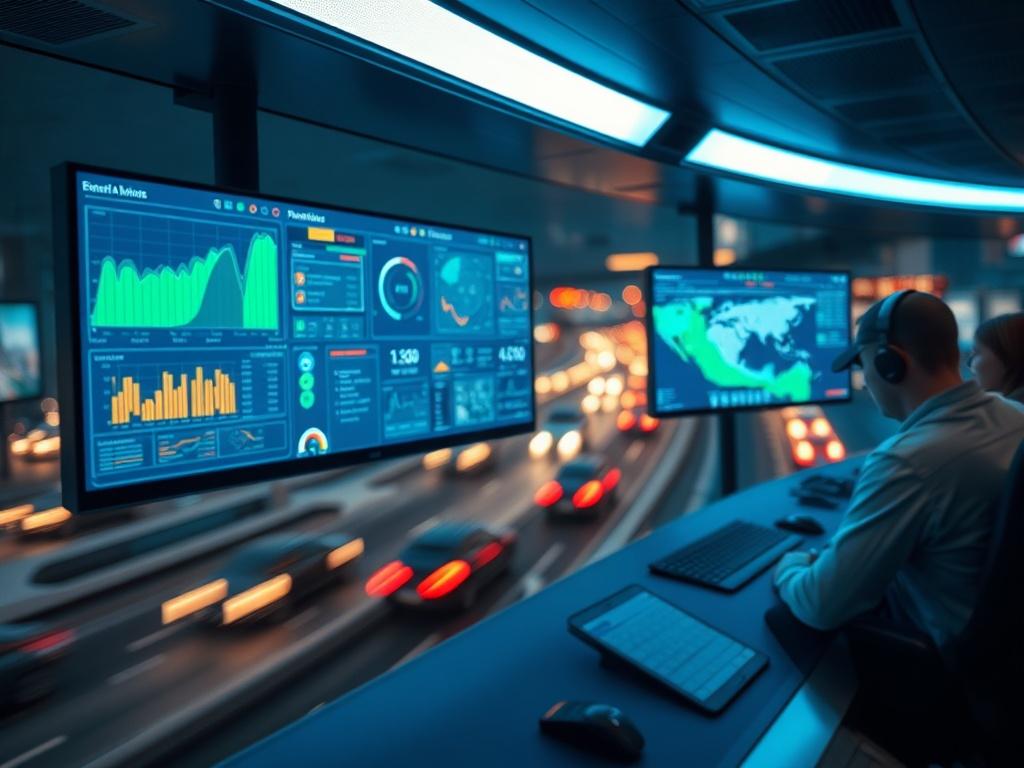
Transportation networks are no longer static public assets. They are becoming real-time, data-driven systems — and cities must evolve their infrastructure accordingly.
We cannot solve 21st-century congestion, freight, and safety challenges with 20th-century infrastructure.
Intelligent Transportation Systems (ITS) are transforming how cities manage traffic flow, freight movement, public transit, and roadway safety. But intelligence does not exist in isolation. It depends on the infrastructure beneath it.
Surge provides the privacy-first, edge-native infrastructure layer that powers modern Intelligent Transportation Systems — enabling real-time performance, scalability, and public trust without relying on invasive, camera-heavy surveillance models.
Intelligent Transportation Systems (ITS) integrate sensing, communication networks, data analytics, and automated control systems to improve how people and goods move through urban environments.
Rather than operating as isolated components, modern ITS infrastructure connects vehicles, intersections, traffic management centers, and cloud platforms into a coordinated, responsive system.
ITS architecture typically includes four core components:
Sensors capture real-time traffic conditions. These may include cameras, radar, environmental sensors, GPS feeds, and vehicle telemetry. They form the foundation of smart city transportation infrastructure.
Data collected at the roadside is transmitted to processing environments via fiber, wireless networks, or vehicle-to-infrastructure (V2I) communication systems. Connected vehicle infrastructure allows vehicles and intersections to exchange information in near real time.
Software platforms analyze traffic data to detect congestion, identify incidents, predict traffic flow, and optimize signal timing. Increasingly, this analysis happens at the edge rather than solely in centralized cloud systems.
ITS systems respond by adjusting signal timing, managing variable speed limits, or distributing real-time traffic updates to drivers and fleet operators.
Together, these components create a responsive transportation network designed to improve safety, reduce congestion, and increase operational efficiency.
Urban populations are growing. Freight demand is increasing. Infrastructure budgets are constrained.
As a result, cities must move more people and goods through the same physical footprint.
Intelligent Transportation Systems address these challenges by enabling:
For example, intelligent traffic signal systems can reduce idle time at intersections, lowering fuel consumption and CO₂ emissions. Smart parking systems can reduce unnecessary vehicle circulation by directing drivers to available spaces in real time.
However, while ITS applications are advancing rapidly, the underlying infrastructure often remains fragmented, centralized, and surveillance-heavy.
The real challenge isn’t whether ITS works. It’s whether the infrastructure architecture behind it can scale securely, sustainably, and with public trust.
Many Intelligent Transportation System deployments today rely on:
This architecture introduces three structural risks:
As cities scale smart transportation initiatives, privacy and resilience cannot be afterthoughts. They must be designed into the system from the beginning.
Surge provides the sensing and edge computing backbone for next-generation ITS infrastructure.
Instead of transmitting raw video or sensitive data to centralized cloud platforms, Surge processes intelligence directly at the intersection — at the edge of the network.
We believe infrastructure should generate insight, not surveillance.
Surge’s smart intersection nodes:
This approach enables real-time transportation analytics while preserving privacy by design.
By deploying intelligent infrastructure directly at the street level, Surge transforms intersections into standardized, revenue-generating data assets for modern transportation systems.
The future of Intelligent Transportation Systems will be defined by infrastructure that is intelligent by default and privacy-preserving by design.
As transportation networks evolve, three requirements must advance together:
Privacy cannot be retrofitted into transportation systems after deployment. It must be embedded into the physical and digital infrastructure from the start.
Surge supports cities, transportation agencies, and mobility partners by delivering:
By strengthening the infrastructure layer beneath Intelligent Transportation Systems, Surge enables cities to operate more safely, efficiently, and responsibly.
The next generation of Intelligent Transportation Systems will not be built on more cameras or more centralized data.
They will be built on resilient, edge-native infrastructure that converts physical intersections into real-time intelligence platforms — without compromising privacy.
At Surge, we are not simply adding sensors to streets. We are rebuilding the infrastructure layer that powers the AI-driven transportation economy.
As cities modernize, infrastructure must evolve from passive concrete and steel into intelligent, privacy-first systems capable of supporting autonomous vehicles, connected freight, and real-time urban optimization.
The intelligence layer is only as strong as the infrastructure beneath it.
Surge is building that foundation.
Surge builds and operates intelligent infrastructure platforms that deliver real-time data for AI-enabled systems. Surge's infrastructure supports cities, enterprises, and partners with reliable, high-quality insights designed for connected, real-world environments. Learn more at www.SurgeNetworks.ai.
Surge Holdings Inc.
Miguel Jaramillo
Co-founder & CEO
info@surgenetworks.ai